Connect systems
Link technical feasibility, user experience, and business outcomes as one integrated system to enable breakthrough solutions.

I stabilize struggling teams and scale healthy ones through systems that work across cultures and time zones.
My experience spans scaling startups to transforming enterprises, creating systems that enable teams to move fast without breaking.
I see AI as amplifying human capability; improving speed and quality while freeing people to focus on deeper, strategic challenges.
I build AI-enabled teams that transform complex ML research into products that save customers millions annually.
Having lived as a developer, designer, and product manager, I naturally align technical feasibility, user experience, and business impact.
This unique perspective enables me to spot opportunities others may miss while building the cross-functional relationships that turn constraints into breakthroughs.
Link technical feasibility, user experience, and business outcomes as one integrated system to enable breakthrough solutions.
Create frameworks and remove obstacles so designers can make autonomous decisions and drive strategic initiatives.
Coach designers into strategic leaders through growth opportunities that shape both individual careers and organizational capability.
Build design systems, research programs, and frameworks that maintain quality while enabling rapid global growth.
Prioritize measurable business results and user impact over outputs to ensure teams solve the right problems effectively.
Comprised of Fourth’s global UX Design team and the Platform Product Management organization.
In addition, I led another 50+ people from our Engineering and Data Science organizations in my VP of Product role.
My direct team included people in Argentina, Bulgaria, the UK, and the US, with additional matrixed teams in South Africa, the Ukraine, and Vietnam.


graphs
graphs
graphs
graphs
graphs

Building a B2B/B2C fintech product

Elevating the ideas of others

Unifying across mergers, codebases & time

A company-changing, design-first initiative

Bringing the customer in-house

Small changes deliver measurable savings

Diving into the details
I'm creating new case studies and updating the older ones.
I craft structures to enable Design to influence business strategy from the earliest stages and throughout the business lifecycle:
Consistency across distributed teams and product lines requires more than shared tools - it demands shared ways of working. I've successfully unified teams across multiple countries by providing systems and guidance over top-down control.
I introduce collaborative ad-hoc conversations and planned workshops to engage cross-functional teams as active participants with the goal of shifting the shared vocabulary from "build features" to "solve user problems". Over time, this customer-focus and user-awareness becomes embedded into the organizational DNA, transforming how people approach problems.

Alex has a real talent for cutting through complexity and noise. Whether we were dealing with organizational ambiguity or a tough product decision, he could bring focus and clarity. He modeled how to reframe a problem, move past debate, and offer a solution others could align around. That approach changed how I think and lead.
He’s also incredibly intentional about developing people. Sometimes that growth is so subtle you don’t even realize it’s happening. Other times, he’ll push you directly by placing you in challenging situations he knows you’re ready for. He saw potential in me before I saw it in myself, and that kind of support is rare.
My job is to provide a clear vision and strategic context while removing obstacles that prevent execution. To do this, I:
World-class organizations attract talent through compelling challenges and opportunities to grow. I recruit for potential and adaptability, then coach for breakthrough results.
Strategic design leadership requires knowing when to direct from above and when to dive into the weeds with the team.
I step into critical design initiatives directly, mentoring managers and team members through complex challenges. I model design excellence standards and expectations, and apply different frameworks to best solve the challenges at hand. I ask a lot of questions.
I ask a lot of questions.

I build teams that deliver breakthrough results while developing individuals into leaders.

Alex brought an incredible depth and breadth of knowledge to every conversation. He has an almost encyclopedic understanding of so many topics, and the ability to quickly grasp new, complex concepts with ease. What stood out most was how collaborative he was—always inclusive, never territorial, and genuinely invested in team success. He regularly pulled me into strategic discussions and brought perspectives I hadn’t considered. Working with him made me better at my job.
Product Managers and Designers have significant overlap in their skills, outlooks and responsibilities, so I position Design as strategic colleagues from the start of a project, not when it's time to execute on a PRD.
We deliver better products, faster when we eliminate friction between disciplines and treat our internal tools as important products in their own right.
Robust research programs make user intelligence a foundational element of strategic planning. I build user testing pools that enable rapid validation and continuous feedback, create "Voice of Customer" programs that unify disparate feedback sources into strategic intelligence, and establish research methodologies that integrate qualitative insights with quantitative analytics. As importantly, I proactively distribute access and insights to other organizations.


Beyond the hype, AI is reshaping design faster than most realize. The best designers who are incorporating AI tools into their flow aren't just working faster, they're using that extra time to dive deeper into the complex challenges they're solving. They're also increasing their fluency in code and product strategy, becoming better, more collaborative teammates. Simply put, reducing repetitive, low value tasks means they can focus on the high-value problem-solving that defines great design.
But this only happens if we proactively carve out time to experiment with new technologies and concepts.
If we're honest with ourselves, we know that these new capabilities comes with challenges that the hype glosses over. I find myself asking these questions of myself often:
I don't have answers but I'm thinking about these challenges a lot and talking through potential paths and ramifications with others in the industry. Those of us who get ahead of this shift have a unique opportunity to build stronger teams and better products. Those who don't risk fading into mediocrity.
Ultimately, the choice isn't about adopting tools. It's about actively shaping how design as a profession evolves.
I use Claude for research, tailoring text, and importantly, as a thinking partner for complex problems. Greg Storey's Creative Intelligence was a catalyst for reframing how I approach AI tools as true collaboration partners.
Replit, Lovable, Bolt… I haven't found a favorite yet as they're fairly interchangeable for my needs. I use them to quickly prototype internal tools and demonstrate feature concepts or iterative ideation.
I've used Claude Code, Cursor, Windsurf, and Warp to generate apps and utilities. Claude Code keeps pulling me back, though Warp's been performing really well lately. I've also started using Supabase as a datastore.
Flow is actively changing how I work. It's the first voice-to-text app that's genuinely more efficient than typing for me. I use it for capturing notes, quick messages, and increasingly for my discussions with Claude.

I built a Figma extension that checks UI copy against the style guide, providing scoring and text recommendations for voice, tone, grammar, and spelling. I've also encouraged members of my teams to use LLMs for one-off needs. For example, a Bulgarian designer used ChatGPT to generate a list of realistic British names for a UI to save time. This the type of work is easily turned into a quick utility and shared with the larger team for everyone's benefit.

I've used Replit and Lovable to build quick prototypes. For example, I built a quick prototype to show my idea for an easy to use app that would allow non-technical users to configure Point of Sale calculations that typically require custom development.

I used Claude to help me convert a Python script into a published Raycast extension for coordinating meetings across timexones. You enter a time like "2PM Tuesday" and your default locations, and it pastes properly formatted times for each location. More information and a link to install the extension is available here.

I built a tailored web app using Claude Code after finding existing tools didn't check all the right boxes. In addition to the standard functionality, I was able to quickly add a bookmarklet to speed the process of adding a new opportunity. Plus, as I can modify it in real-time, it continuously improves as I use it.
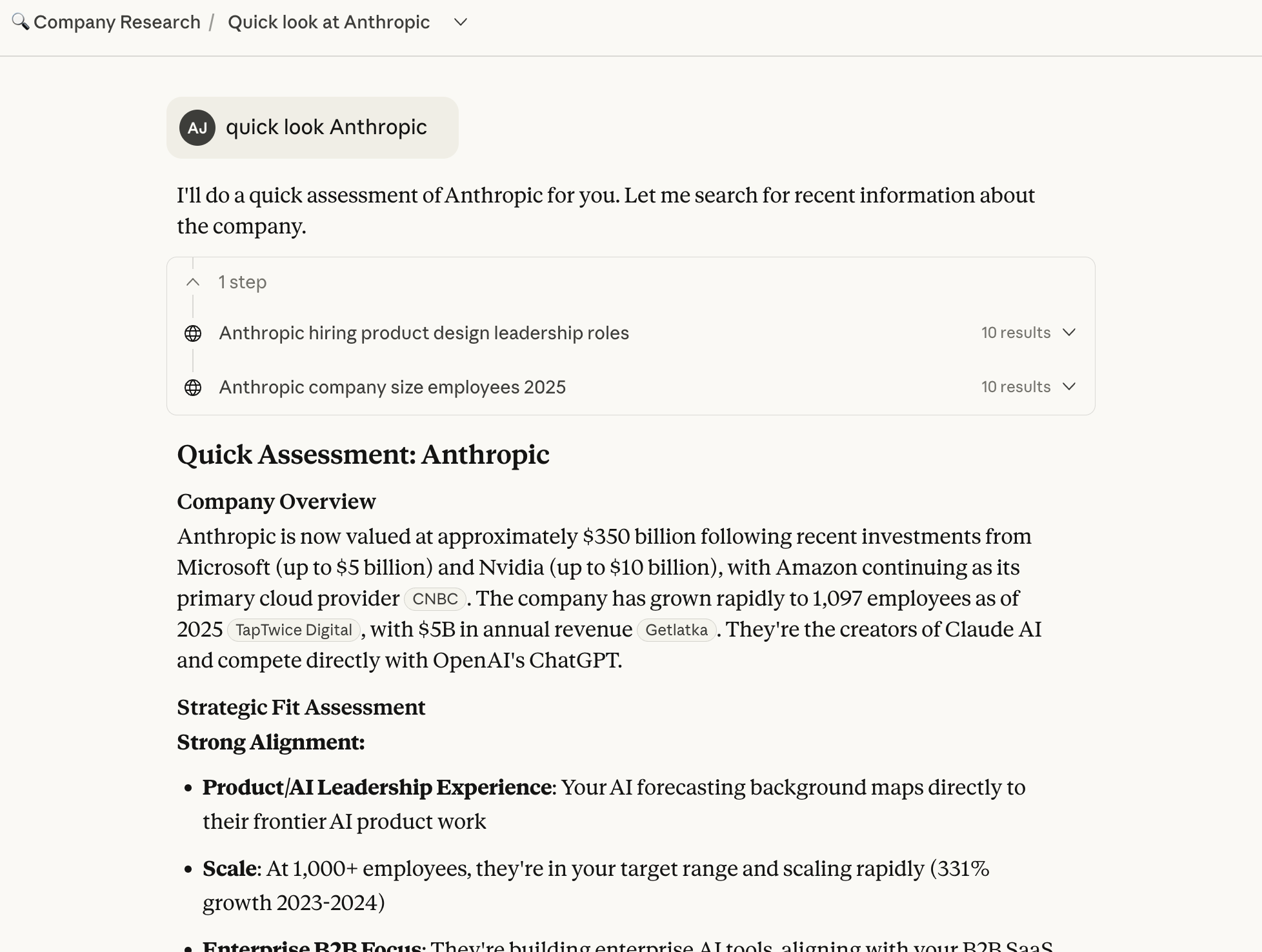
I set up a Claude project that generates comprehensive company analyses with cited sources, red flag detection, and strategic fit evaluation against my background, goals and experience.

Throughout our time together, Alex was incredibly supportive. He taught me the best ways to use data for decision-making and was always a great soundboard when I had product management questions. His dedication, tough but fair approach to managing, and his intelligence make him a true product leader. Our team went through a lot of changes and turmoil but thanks to Alex’s guidance and support we were able to persevere to become a high performing unit.
Excellence emerges through continuous improvement, so I establish frameworks to make UX quality measurable, visible, and accountable for business outcomes.
I create cultures that proactively enhance user satisfaction while driving business results by
Excellence emerges through systematic measurement and continuous improvement. I establish frameworks that make UX quality visible, measurable, and are tied to business outcomes.
User experience metrics tied directly to business outcomes and customer retention indicators

From day one, Alex provided a much needed calming, confident, and positive leadership style with an intuitive understanding of what initiatives were critical for the business despite many voices telling him that everything was critical. He instantly gained the respect of his UX/UI team, as well as the Product and Engineering teams.

You can’t manage someone’s performance; you can only help them manage it themselves
Published in Modus

[Alex] truly cares about everybody on his team succeeding and building a satisfying career while achieving business goals. I’ve learned a lot from Alex and his communication skills.

How I interview people for my design team, peers in other teams and my potential boss
Published in UX Collective

Some thoughts from a Design leader who’s learned to embrace ambiguity
Published in UX Planet

Alex is one of the most talented and dedicated product managers I have had the pleasure to work with. I would highly recommend him to any team looking for an intelligent, creative and thoughtful leader.
To be a good design leader, encourage your team to challenge your decisions
Published in Modus
Instead, build an environment that enables real responsibility and growth
Published in Modus

Published in Prototypr
A mentor can be a huge boon to your career development, but you’ll need to come prepared
Published in Modus

I've been very lucky in my career to have worked with some of the best and brightest and Alex falls squarely into that group. You can tell easily where his passions lie and they shine through in his execution and management of his team. Not just that, Alex is one of the nicest guys you'll ever meet. His egalitarian and open view of the work place and how it should be run is a breath of fresh air and leads to a team dynamic that shows in it's quality and productivity.